

Emotional Journaling: 15 Prompts for Emotional Regulation on Difficult Days
Emotional journaling is a structured form of journaling for emotional regulation that helps you name what you feel, notice what may have intensified it, and choose a response before reacting from the strongest part of the emotion. It does not mean suppressing anger, sadness, fear, or disappointment. It means giving yourself enough space to understand what is happening and decide what needs attention now.
Quick Answer: Emotional regulation journaling helps you write down the emotion, trigger, thoughts, needs, and possible next step. A few focused questions can be more useful than writing without direction, especially on difficult days when your mind feels crowded.
This guide is for high-performing women who are carrying pressure, overthinking a conversation, processing a demanding day, or trying to respond more thoughtfully. You will find a simple check-in method, 15 prompts, one practical table, and a five-minute exercise you can use without making journaling feel like another task to perform.
What Is Journaling for Emotional Regulation?
Emotional regulation is the process of recognizing an emotion, understanding what may be influencing it, and choosing how to respond. It is not about pretending you are fine. It is not about forcing positivity or blaming yourself for having a human reaction.
A journal can give you one place to record the emotion, its intensity, the situation around it, the thoughts connected to it, and the physical sensations you notice. It can also help you separate assumptions from facts, identify needs, and decide which action is useful.
Emotion journaling may feel more manageable when it stays clear and specific. You are not trying to write until every feeling disappears. You are gathering information so you can respond with more steadiness.
How Can Writing Help You Understand an Emotion?
Writing may help some people slow down before reacting, put feelings into words, organize competing thoughts, and notice repeated patterns. It can also help you separate what happened from what you are interpreting, which matters when emotions are intense.
A recent expressive-writing study describes expressive writing as writing about difficult experiences while focusing on feelings and emotions, and it explores how writing instructions can influence outcomes. That is one reason this article uses focused prompts instead of asking you to empty everything onto the page.
The research is not a simple promise, though. A meta-analysis on expressive writing reported mixed and limited findings, which is why journaling should not be framed as a cure, treatment, or guaranteed solution. Benefits vary by person, situation, timing, and how the writing is done.
Writing can also increase distress temporarily. You can stop at any time, close the notebook, drink water, use a grounding practice, or ask for support. Your journal should serve your clarity, not push you into emotional flooding.

How to Journal Without Making Yourself Feel More Overwhelmed
Journaling difficult emotions may feel more manageable when it has a clear structure. Without one, writing can drift into replaying the same situation again and again.
- Set a short time limit. Five to ten minutes can be a useful starting point. This is not a rule or a medical requirement. It is simply a way to keep the entry manageable.
- Choose one current situation. Pick one conversation, decision, message, or moment. Do not ask yourself to process every difficult experience at once.
- Write for clarity, not perfect grammar. Your journal does not need polished sentences. It is private unless you choose to share it.
- Name what is happening now. Start with the present situation before exploring older experiences. If the entry begins pulling you into severe trauma memories, pause and seek appropriate support.
- Stop when writing becomes unmanageable. If writing causes escalating distress, panic, severe emotional flooding, or a sense of being unsafe, stop. You do not have to push through.
- End with one stabilizing question. Ask, “What do I need now?” “What can wait?” “What is one safe next step?” or “Who could support me?”
A Simple Five-Part Emotional Check-In
Use this five-part check-in when you want a short structure. For many women, journaling for emotional regulation starts with one honest check-in, not a long entry. It can help you move from emotional intensity toward a clearer next step.
- Emotion: What am I feeling?
- Trigger: What happened immediately before this feeling became stronger?
- Thought: What am I telling myself about what happened?
- Need: What may be missing or required right now?
- Response: What is the most helpful and realistic next step?
For example, you might write: “I feel tense and dismissed after the meeting. The trigger was being interrupted twice. I am telling myself my idea did not matter, but the fact is that I was interrupted and the discussion moved quickly. I need clarity and a chance to finish my point. My next step is to send a concise follow-up email.”
| Journal focus | Question to ask | What it may clarify |
|---|---|---|
| Emotion | What am I feeling? | The core feeling |
| Trigger | What happened first? | The immediate spark |
| Thought | What am I telling myself? | The inner story |
| Fact | What do I know? | Observable details |
| Assumption | What am I guessing? | Unconfirmed meaning |
| Need | What is missing? | Support or clarity |
| Boundary | What limit may help? | Pressure points |
| Next step | What now? | A realistic action |
15 Journaling Prompts for Emotional Regulation
You do not need to answer all 15 prompts in one sitting. Choose the group that matches the question you are carrying right now.
Prompts to Name What You Are Feeling
- What emotion is most present right now, and what word describes it most accurately?
- Where do I notice this emotion in my body, and what does the sensation feel like?
- If this emotion could communicate one message, what might it be trying to tell me?
Emotions can offer information, but they are not always complete evidence about a situation. Treat them as signals to understand, not orders you must immediately obey.
Prompts to Understand the Trigger
- What happened immediately before my emotional reaction became stronger?
- Was I reacting only to this situation, or had pressure already been building?
- What part of this situation felt most difficult: the event, the timing, the uncertainty, the expectation, or the way I was treated?
If pressure has been building for weeks, your reaction may be carrying more than one moment. Yolanda’s article on signs of emotional exhaustion can help you recognize when depletion may be part of the picture.
Prompts to Separate Facts From Assumptions
- What do I know happened, based only on what I directly saw, heard, or received?
- What am I assuming about the other person, the future, or what this situation means?
- What is another reasonable explanation that I have not considered?
This step is not about dismissing genuine mistreatment or ignoring evidence. It is about noticing when your mind has moved from what happened into what you fear it means. If the same thought loop keeps returning, read Yolanda’s guide on how to stop overthinking.
Prompts to Identify Needs and Boundaries
- What do I need more of right now: clarity, rest, time, support, information, privacy, or space?
- What request, limit, or boundary could reduce the pressure in this situation?
- Am I taking responsibility for something that belongs partly or completely to someone else?
When your journal keeps pointing toward a limit that needs to be named, Yolanda’s article on setting boundaries without feeling guilty can help you think through that next layer.
Prompts to Choose a Clearer Next Step
- What part of this situation requires action, and what part only requires time?
- What is the smallest useful action I can take within the next day?
- What would a response based on my values look like, rather than a response based only on the intensity of this emotion?
If a difficult season has made it harder to trust your own response, the article on rebuilding self-worth after a difficult season may be a supportive next read.
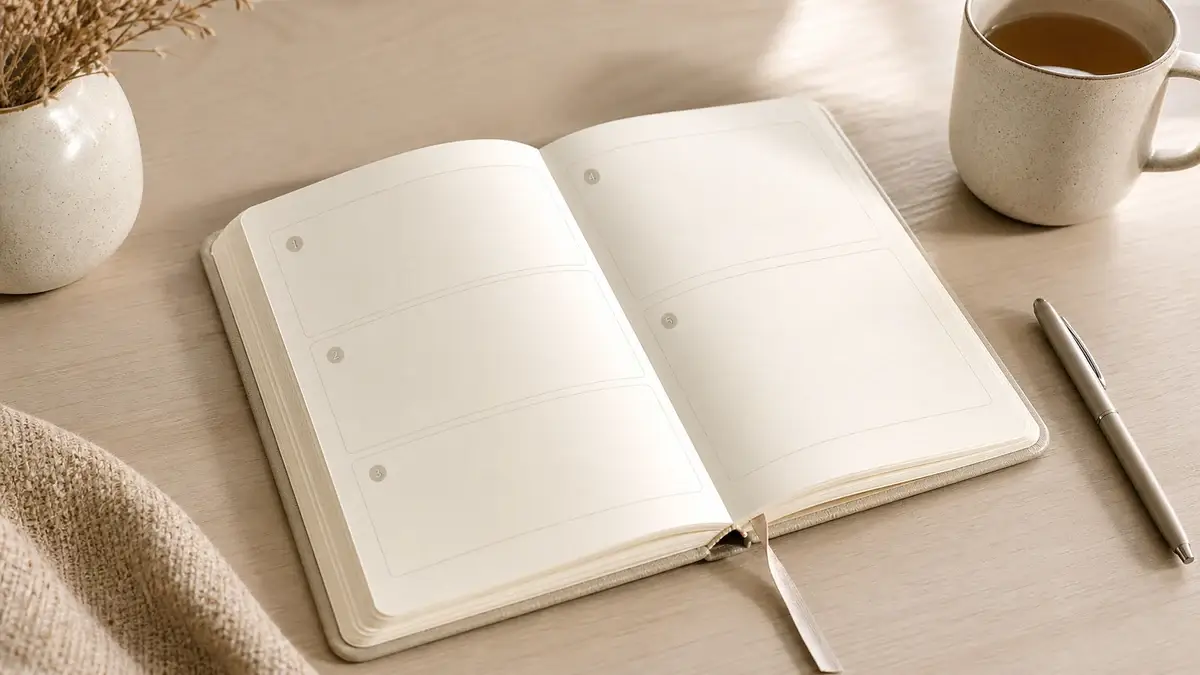
Try This Five-Minute Emotion Journaling Exercise
Try This Now:
Minute 1: Write the emotion and its intensity from 1 to 10.
Minute 2: Write what happened immediately before it became stronger.
Minute 3: Separate what you know from what you are assuming.
Minute 4: Write what you need or what boundary may be missing.
Minute 5: Choose one realistic next step.
Close with: “I do not need to solve everything in this journal entry.”
The intensity number is a personal reflection tool, not a diagnostic score. It can simply help you notice whether an emotion feels mild, moderate, or very strong in that moment.
How to Avoid Turning Journaling Into Rumination
Journaling becomes less helpful when it turns into rehearsing arguments, proving your worth, predicting worst-case outcomes, or judging every emotional reaction. If you finish every entry feeling more activated, the structure may need to change.
Move from “Why did this happen?” toward “What do I know, what do I need, and what can I do next?” This shift does not erase the emotion. It gives your attention somewhere useful to land.
You can set a time limit, separate facts from assumptions, end with one need, take a break, or use a short grounding exercise. Since grounding yourself can help bring attention back to the present moment, it may be a useful companion when writing starts to feel too intense.
When Journaling May Not Be the Right Tool
Journaling is not useful in every moment. Stop writing, pause, or choose another form of support if the process significantly intensifies distress, triggers severe or traumatic memories, creates panic, or makes you feel unsafe.
It may also be time to step away if journaling becomes compulsive, increases self-criticism, prevents action or communication, replaces needed care, or feels impossible to stop. A journal should not become the place where you argue against your own humanity.
The National Institute of Mental Health notes that self-care looks different for everyone, and that finding what helps may take trial and error. Your useful support system may include writing, rest, movement, conversation, professional care, or time away from the page.
When Should You Seek Professional Support?
Consider professional support when emotional distress continues for a prolonged period, feels severe or difficult to manage, seriously affects sleep, disrupts work or responsibilities, damages important relationships, or brings persistent hopelessness or fear.
Support is also important when distress is connected to difficult or traumatic experiences, makes you feel unsafe, includes thoughts of self-harm, or does not improve despite reasonable self-help efforts. The NIMH guide on when to seek help can help readers think through when symptoms may need professional attention.
If you may harm yourself, cannot stay safe or are in immediate danger, contact your local emergency services or an available crisis service immediately.
Write Toward Clarity, Not Perfection
You do not need beautiful writing for a journal entry to be useful. Journaling for emotional regulation is about building a truthful pause, not producing perfect pages. One honest sentence can help you notice the difference between an emotion, a thought, a need, and a choice.
Not every feeling requires immediate action. Some feelings need rest, support, boundaries, or time. Practical guidance from Yolanda Dean can help you keep the goal simple: understand what is happening, then choose one steadier next step.
Frequently Asked Questions
Journaling can help with emotional regulation by giving you a structured way to name the emotion, identify the trigger, notice the thoughts attached to it, and choose a response. It may create a pause between feeling something strongly and reacting immediately. It does not work the same way for everyone, and it should not be treated as therapy or a guaranteed solution.
When you feel emotionally overwhelmed, start with one current situation. Write what you feel, what happened just before the emotion became stronger, what you know for sure, what you may be assuming, and what you need now. End with one realistic next step. Keep the entry short if writing more makes you feel flooded.
There is no required schedule for journaling about emotions. Some people write for a few minutes when a situation feels intense, while others journal once or twice a week. The useful question is whether the practice helps you gain clarity. If it becomes compulsive, harsh, or overwhelming, take a break and choose another kind of support.
Yes, journaling can make difficult emotions feel worse for some people, especially if the writing turns into rumination or brings up severe distress. Stop if writing significantly increases panic, emotional flooding, self-criticism, or a sense of being unsafe. You can ground yourself, talk with someone you trust, or seek professional support when needed.
Talk to a professional when emotional distress continues, feels severe, affects sleep, work, relationships, safety, or daily functioning, or connects to difficult or traumatic experiences. Journaling can support reflection, but it should not replace needed care. If you may harm yourself, cannot stay safe, or are in immediate danger, contact emergency services or an available crisis service immediately.
Disclaimer: This article is for education and encouragement only. It is not medical advice. If stress, burnout, anxiety, trauma, depression, or emotional distress is affecting your health, safety, sleep, work, relationships, or ability to function, please consider speaking with a licensed medical or mental health professional.
Create Space for a Clearer Response
Journaling can create a pause between an intense emotion and an immediate reaction. Yolanda’s practical resilience and recovery resources can help you understand what is draining your capacity and choose a steadier next step.
- Explore Yolanda’s digital guides for practical resilience and recovery resources.
- Use RESET Under Pressure™ when pressure is high and you need a grounded reflection point.
- Start with The 7-Day Reset when you want a practical rhythm for reflection and recovery.
- Book a 30-minute conversation with Yolanda if you want support choosing the next step.
You can also explore resilience and recovery support or learn about Yolanda’s approach.